The Meeting is taking a minute to review selected Nobel Peace Prize recipients in the light of the meaning of the Friend’s religion. To this purpose, as Friends, we seek to offer social action pathways according to the direction given from the Nobel Prize committee for specific concerns of peace prize recipients.
The Nobel Committee honorees for Peace have significance to Friends because the Nobel committee has honored the recipients of its prize without respect of nationality, gender, or religion. Further, the prize recipients are known for their work, both religious, or political, whose specific outcome helps societies achieve, conduct, or maintain peacefulness. The meeting, in this minute, will list Nobel peace prize honorees according to certain themes which permit Friends to work non-violently towards a peaceful society.

The goal of the Nobel Peace Prize is to acknowledge the work of peace in the world that has been done by people regardless of faith, nationality, gender, or religion. Quakers, in their religion speak about peace first, and then love, through their ministry. The social action of Friends promotes the work of peace. Friends do not discriminate a person’s message when it is received from a non-Christian. Further, Quakers involve themselves in the work of peace for Christians and non-Christians alike without reference to faith, nationality, or gender.
First, Friends receive, in the light, Peace. Called the peace testimony, as Friends, we first believe in peace as non-violence. The peace testimony is a guide to action. We are guided by our faith in Christ as a lord who directs us to not conduct violent war. We involve ourselves in speech and action that resolves personal and professional conflicts by means of activities that are non-violent, and do not lead to war. Also, Friends believe, in the light, that peace is associated with simplicity and integrity. The conduct of peace, simplicity, and integrity takes place for the sake of community, equality, and stewardship.
The guidance Quakers do not speak about, and do not act with regard to, is love. Love is that in the light the spirit guides us to which remains hidden.
You are encouraged to hold these peace leaders in the light and ask if they or their organization speaks for your conscience. The Meeting has provided information about how to take action on the peace leaders initiatives, or how to volunteer for an organization.
Society of Friends (Quakers)
Quakers view of the Nobel Peace Prize depends upon the reception of this award in 1947. Essentially, arising out of receiving support for their need for refuge in the 17th and 18th centuries, Quakers, in return offered refuge and assistance in great numbers to others.
“The unarmed only can draw on source’s eternal. The spirit alone gives victory.” -Arnulf Överland. The Nobel Peace Prize of 1947 recognizes the Quaker Peace Testimony as instrumental in assisting relief efforts for civilian victims of WWII.
Learn more about Quaker Peace and Social Witness (QPSW)
Click the button below to visit the Quaker Peace and Social Witness website.
Non-Nuclear Conflict
Of great concern to advocates for peace, the violence inflicted by nuclear conflict is condemned universally. Non-nuclear conflict is non-violent in action.
The Nobel Peace Prize Committee consistently recognizes efforts to achieve nuclear disarmament and arms control.
Quakers condemn violent conflict and deny all forms of nuclear proliferation.
“No more Hibakusha.” In 2024, awarded to Nihon Hidankyo, or The Japan Confederation of A- and H-Bomb Sufferers Organizations. These survivors of the U.S. bombing of Hiroshima and Nagasaki organized in 1956 to protect the rights of the 650,000 survivors and to publicize the personal testimonies of the remaining survivors.
Read the remaining survivor’s personal testimonies here.
“When I was a 13-year-old girl, trapped in the smoldering rubble, I kept pushing. I kept moving toward the light. And I survived. Our light now is [to] the ban treaty.” -Setsuko Thurlow.
The wise sayings of the Hibakusha, or survivors, are testimony to the damage done by hate and violent confrontation.
ICAN, International Campaign to Abolish Nuclear Weapons, 2017.
“ICAN is the international campaign to stigmatise(sic), prohibit & eliminate nuclear weapons.” (from the ICAN website)
Linus Carl Pauling, 1962. “The goal (of disarmament) is no longer a dream. It is a practical matter of life or death. The risks inherent in disarmament pale in comparison to the risks inherent in an unlimited arms race…”
The Work of Peace
Acting as a non-violent state is a message from the Quaker testimony of peace. The Nobel Committee has recognized these three persons, among others, for their political activity that means peace in politics.
Maria Corina Machado, 2025. “Venezuela also became a refuge.
We opened our arms to…families from Colombia, Lebanon and Syria seeking peace… And they became Venezuelans. This is Venezuela.”
Barak Obama, 2009. “Now is the time for all of us to take our share of responsibility for a global response to global challenges.”
Tenzin Gyatso, The 14th Dalai Lama, 1989. “I believe all religions pursue the same goals, that of cultivating human goodness and bringing happiness to all human beings.”
Peaceful World Leaders
Refugees
The UN High Commission for Refugees (UNHCR), 1954, 1981. “Aid to refugees was defined as fundamental work for peace…by the Nobel peace prize committee.
The World Food Programme, 2020. ” ‘peace and brotherhood’ – let’s feed them all. Food is the pathway to peace.”
Read the Worship Center’s Minute of Conscience on Refugees Here
League of Nations
Léon Bourgeois, 1920. “To assert that it is possible to establish peace between men of different nations is simply to assert that man…whatever…his race, religious beliefs, or philosophy, is capable of reason.”
Thomas Woodrow Wilson, 1919. ” For mankind has not yet been rid of the unspeakable horror of war.”
Christian Lange and Hjalmar Branting, 1921. “Jesus of Nazareth was a pacifist.” and ” the League of Nations. To create an organization which is in a position to protect peace in this world.”
Testimonies of Peace
Quakers Speak has produced a video called, “Examining the Peace Testimony.” Offered by Adria Gulizia of Chatham-Summit Friends Meeting, it is worth watching.
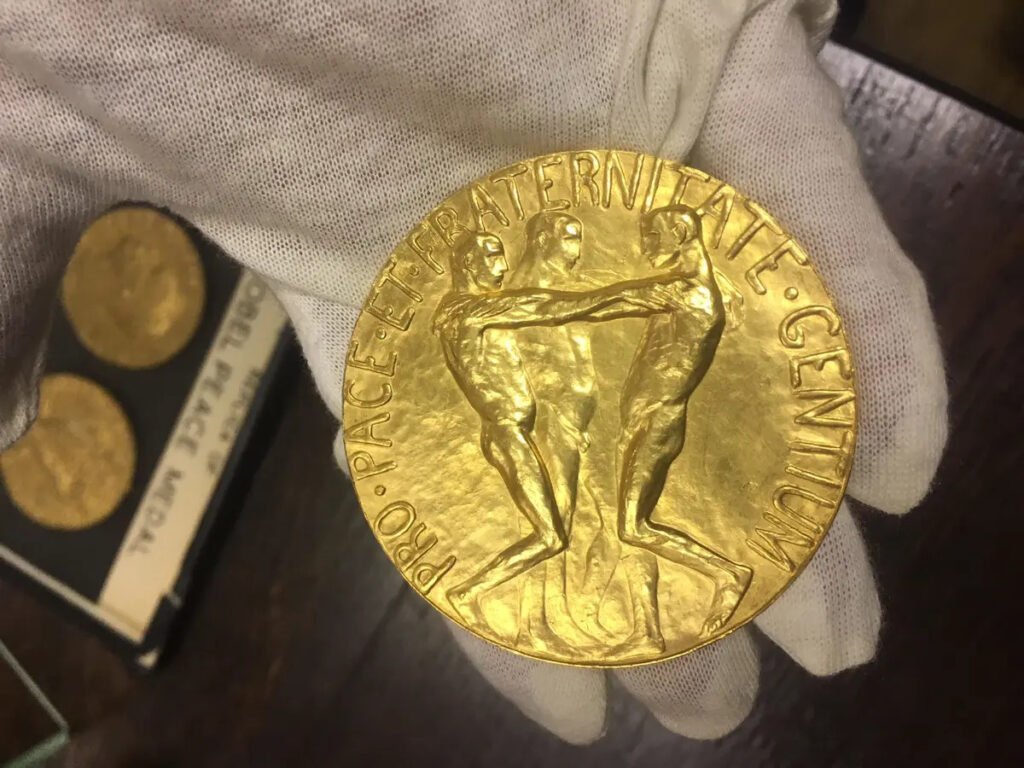
Friends hold in the light the Nobel peace prize received by the AFSC of the United States and the FSC of Britain. Compassion, reconciliation, peace. These messages come together in the reception of the Nobel peace prize by the Quakers. The expression- the work these messages call for is the end of violent war. The Meeting has listed organizations and contacts for these organizations to allow Friends to actively work for peace. This Meeting approves the work of peace with limited application to the message No Violent Wars. The meeting encourages Friend’s meetings to provide peaceful activities as services which members and non-members can take part in.
Leave a Comment
You must be logged in to post a comment.
Leave a Comment
You must be logged in to post a comment.