For this group of worldwide displaced persons the Meeting has provided direction to learn more about who is providing leadership for displaced persons in their region.
The Meeting is taking a minute to review selected Nobel Peace Prize recipients in the light of the meaning of the Friend’s religion. To this purpose, as Friends, we seek to offer social action pathways according to the direction given from the Nobel Prize committee for specific concerns of peace prize recipients.
The Nobel Committee honorees for Peace have significance to Friends because the Nobel committee has honored the recipients of its prize without respect of nationality, gender, or religion. Further, the prize recipients are known for their work, both religious, or political, whose specific outcome helps societies achieve, conduct, or maintain peacefulness. The meeting, in this minute, will list Nobel peace prize honorees according to certain themes which permit Friends to work non-violently towards a peaceful society.

The goal of the Nobel Peace Prize is to acknowledge the work of peace in the world that has been done by people regardless of faith, nationality, gender, or religion. Quakers, in their religion speak about peace first, and then love, through their ministry. The social action of Friends promotes the work of peace. Friends do not discriminate a person’s message when it is received from a non-Christian. Further, Quakers involve themselves in the work of peace for Christians and non-Christians alike without reference to faith, nationality, or gender.
First, Friends receive, in the light, Peace. Called the peace testimony, as Friends, we first believe in peace as non-violence. The peace testimony is a guide to action. We are guided by our faith in Christ as a lord who directs us to not conduct violent war. We involve ourselves in speech and action that resolves personal and professional conflicts by means of activities that are non-violent, and do not lead to war. Also, Friends believe, in the light, that peace is associated with simplicity and integrity. The conduct of peace, simplicity, and integrity takes place for the sake of community, equality, and stewardship.
The guidance Quakers do not speak about, and do not act with regard to, is love. Love is that in the light the spirit guides us to which remains hidden.
You are encouraged to hold these peace leaders in the light and ask if they or their organization speaks for your conscience. The Meeting has provided information about how to take action on the peace leaders initiatives, or how to volunteer for an organization.
Society of Friends (Quakers)
Quakers view of the Nobel Peace Prize depends upon the reception of this award in 1947. Essentially, arising out of receiving support for their need for refuge in the 17th and 18th centuries, Quakers, in return offered refuge and assistance in great numbers to others.
“The unarmed only can draw on source’s eternal. The spirit alone gives victory.” -Arnulf Överland. The Nobel Peace Prize of 1947 recognizes the Quaker Peace Testimony as instrumental in assisting relief efforts for civilian victims of WWII.
Learn more about Quaker Peace and Social Witness (QPSW)
Click the button below to visit the Quaker Peace and Social Witness website.
Non-Nuclear Conflict
Of great concern to advocates for peace, the violence inflicted by nuclear conflict is condemned universally. Non-nuclear conflict is non-violent in action.
The Nobel Peace Prize Committee consistently recognizes efforts to achieve nuclear disarmament and arms control.
Quakers condemn violent conflict and deny all forms of nuclear proliferation.
“No more Hibakusha.” In 2024, awarded to Nihon Hidankyo, or The Japan Confederation of A- and H-Bomb Sufferers Organizations. These survivors of the U.S. bombing of Hiroshima and Nagasaki organized in 1956 to protect the rights of the 650,000 survivors and to publicize the personal testimonies of the remaining survivors.
Read the remaining survivor’s personal testimonies here.
“When I was a 13-year-old girl, trapped in the smoldering rubble, I kept pushing. I kept moving toward the light. And I survived. Our light now is [to] the ban treaty.” -Setsuko Thurlow.
The wise sayings of the Hibakusha, or survivors, are testimony to the damage done by hate and violent confrontation.
ICAN, International Campaign to Abolish Nuclear Weapons, 2017.
“ICAN is the international campaign to stigmatise(sic), prohibit & eliminate nuclear weapons.” (from the ICAN website)
Linus Carl Pauling, 1962. “The goal (of disarmament) is no longer a dream. It is a practical matter of life or death. The risks inherent in disarmament pale in comparison to the risks inherent in an unlimited arms race…”
The Work of Peace
Acting as a non-violent state is a message from the Quaker testimony of peace. The Nobel Committee has recognized these three persons, among others, for their political activity that means peace in politics.
Maria Corina Machado, 2025. “Venezuela also became a refuge.
We opened our arms to…families from Colombia, Lebanon and Syria seeking peace… And they became Venezuelans. This is Venezuela.”
Barak Obama, 2009. “Now is the time for all of us to take our share of responsibility for a global response to global challenges.”
Tenzin Gyatso, The 14th Dalai Lama, 1989. “I believe all religions pursue the same goals, that of cultivating human goodness and bringing happiness to all human beings.”
Peaceful World Leaders
Refugees
The UN High Commission for Refugees (UNHCR), 1954, 1981. “Aid to refugees was defined as fundamental work for peace…by the Nobel peace prize committee.
The World Food Programme, 2020. ” ‘peace and brotherhood’ – let’s feed them all. Food is the pathway to peace.”
Read the Worship Center’s Minute of Conscience on Refugees Here
League of Nations
Léon Bourgeois, 1920. “To assert that it is possible to establish peace between men of different nations is simply to assert that man…whatever…his race, religious beliefs, or philosophy, is capable of reason.”
Thomas Woodrow Wilson, 1919. ” For mankind has not yet been rid of the unspeakable horror of war.”
Christian Lange and Hjalmar Branting, 1921. “Jesus of Nazareth was a pacifist.” and ” the League of Nations. To create an organization which is in a position to protect peace in this world.”
Testimonies of Peace
Quakers Speak has produced a video called, “Examining the Peace Testimony.” Offered by Adria Gulizia of Chatham-Summit Friends Meeting, it is worth watching.
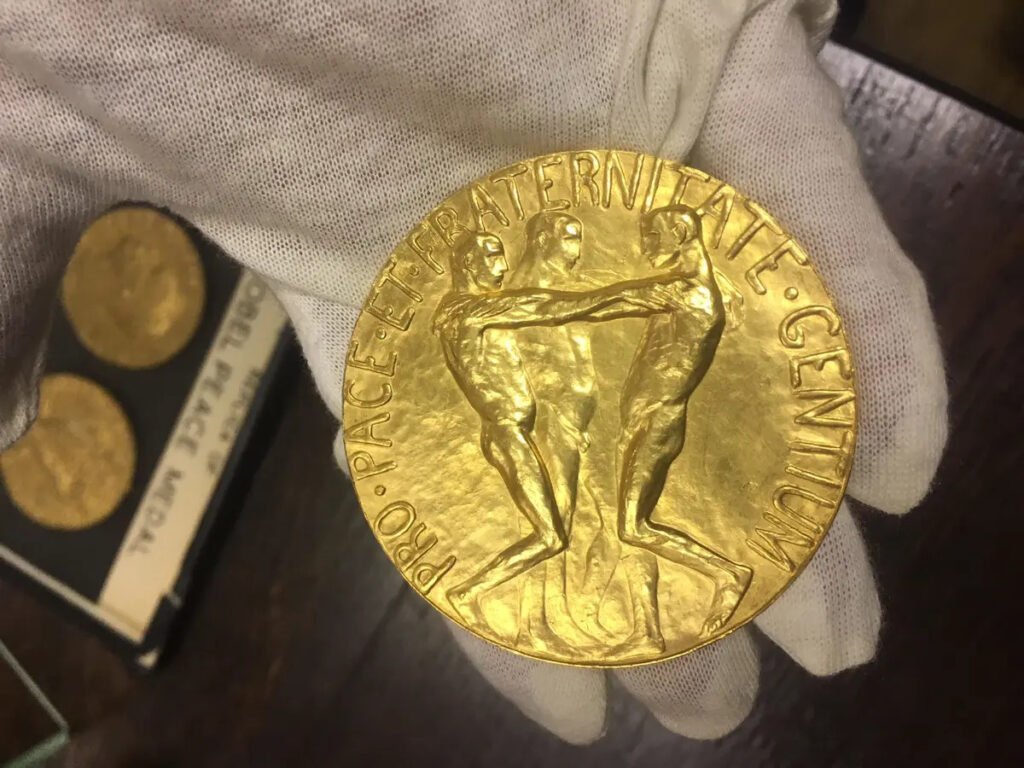
Friends hold in the light the Nobel peace prize received by the AFSC of the United States and the FSC of Britain. Compassion, reconciliation, peace. These messages come together in the reception of the Nobel peace prize by the Quakers. The expression- the work these messages call for is the end of violent war. The Meeting has listed organizations and contacts for these organizations to allow Friends to actively work for peace. This Meeting approves the work of peace with limited application to the message No Violent Wars. The meeting encourages Friend’s meetings to provide peaceful activities as services which members and non-members can take part in.
Leave a Comment
You must be logged in to post a comment.
The U.S. policy of ever-increasing amounts of military aid that spans administrations belonging to both political parties is of concern and asks for a Friend’s witness to the Testimony of Peace. In recent years an alarming amount of money specifically meant to buy munitions has been given to Israel and Ukraine. In the same gesture, congressionally mandated ties required of that money to humanitarian aid have been cancelled. It is beholden upon Friends to consider testimony to the violent intentions of the U.S. government.
The testimony of peace is understood by The Meeting as inward faith. The Meeting asks each member and attender to express this testimony according to the guidance of the Spirit. The Meeting’s guidance is that peace concerns peaceful activities rather than opposition to war. The spirit of this Minute is that the concern is about the activity of violence in the light of the testimony of peace.
Quakers have given various messages in testimony against violent actions. These messages have been statements against killing other people. War is the aggressive act of killing people for a government to achieve its goals. The most obvious vehicle of war is the bullet. And missiles and bombs are also bullets, so to speak. The Meeting points out that setting a goal of achieving political success through acts of war without concomitantly conducting humanitarian actions is misguided. The Meeting acts to make the statement humanitarian aid is required to be a part of a military aid package in order to satisfy the demands of peaceful people. Further, The Meeting insists the great amount of aid provided to Ukraine, Afghanistan, and Israel is inconsistent with the demands of the government to guarantee peace in the United States of America. The Meeting affirms that the great volume of military aid provided to these foreign governments serves the domestic needs of those governments in the absence of the needs of the citizens of the United Staes of America. The Meeting stops short of the statement that the bumming of bullets from U.S. citizens is in service of special interests in those countries. In its defense, The Meeting insists when foreign governments ask it for bullets in order to kill their friends and enemies, in other words, to use aggressive violence against innocent civilians in order to achieve political objectives, they have asked the members of The Meeting to go against the Golden Rule, that is, “Do to others what you would have them do to you.” (Matt. 7:12) Generally, it is the statement of Quakers that ‘do to you’ refers to Christ’s commandment to love each-other as so he loves. (cf. Jn. 13:34)
The Meeting insists on calling the governments of Ukraine, Afghanistan, and Israel bums. The demand, and agreement, that the government of the U.S. purchase bullets, missiles, and bombs for them and for the purpose of killing their political opposition -including innocent men, women, and children goes beyond the requirements U.S. citizens have as a good neighbor, or even an ally. Our government’s lack of temperance to this demand by refusing to require significant humanitarian aid in order to satisfy the requests of foreign governments is objected to by a political party.
The Meeting remains non-partisan. The Meeting asks members, attenders, and interested person to be guided by the spirit to deliver its message in order to act to speak to our government. The Meeting counsel’s peaceful activities in place of any duty to confront or protest any official representative.

Eph. 6-12 (Wycliffe Bible) For why striving is not to us against flesh and blood, but against princes and potentates, against governors of the world of these darknesses, against spiritual things of wickedness, in heavenly things.
Friend's Online Meeting believes it has a responsibility to act about the finagling of Trump Administration policies
… this Meeting wants to act in order to speak to the finagling of the current Trump Administration.
From The Minute of Concern on Finagling Trump Administration Policies
A growing number of Quaker meetings nationwide have gone to the trouble to write a minute of concern regarding Trump Administration actions and policies. A list of such meetings can be found on the websites of yearly meetings like the Pacific Yearly Meeting, and the Friend’s General Conference.
This concern appears to go beyond the party preference of the meeting’s membership. Reviewing the party preferences of Quakers, Pew Research reports that at least half of non-evangelical Christians belong to each party. But, there may be more Democrats who are Quakers. However, this Meeting expresses the belief that acting on a testimony should not favor a party in politics. Rather, we would like to act from consensus, even if consensus favors one political party’s belief or another. The reason is consensus does and should reflect what we say as a group.
Traditionally, members of Meetings rely on the testimony of Equality in order to vote. Equally, members of Meetings rely on the testimony of Integrity to value simplicity. Although simplicity allows us to act on the advice of either party, we are cautioned not to act as though we believe that party, regardless. Rather, our actions should be guided by the “inner light.” If we seem to belong to one party, or another, we can be assured that we are “children of God.”
According to this and similar messages, this Meeting wants to act in order to speak to the finagling of the current Trump Administration.
…this Meeting expresses the belief that acting on a testimony should not be to favor a party in politics…
From The Minute of Concern on Finagling Trump Administration Policies
We know that finagling is defined as acting deviously or dishonestly, especially to get something accomplished. We also know that the Trump Administration, both the current administration, and the past Trump Administration is perceived as very narrowly representing American interests.
- Witness the long and morally difficult list of worldwide dictators the U.S. president has embraced. This list includes Pres. Putin, Russia, Pres. Dutarte, Philippines, former Pres. Bolesaro, Brazil, Pres. Il, N. Korea, etc. According to the witness of Friends, dictators lack integrity. Our light reveals to us that these Presidents, and others, deny their citizen’ s right to the witness of equality. In our view, these citizens are denied the right to participate in their countries political process, whether that denial be fair or unfair. (Ref. https://www.npr.org/2017/05/02/526520042/6-strongmen-trumps-praised-and-the-conflicts-it-presents.)
- Witness the challenges to our Constitution carried out by both Trump Administrations, including:
- Erosion of Constitutional powers. (ref. https://www.hsgac.senate.gov/wp-content/uploads/hSGAC-Minority-Staff-Report.Undermining-Constitutional-Limits-FINAL.pdf.)
- Defiance of court orders. ( Ref. https://www.hsgac.senate.gov/wp-content/uploads/hSGAC-Minority-Staff-Report.Undermining-Constitutional-Limits-FINAL.pdf.)
- Intimidation campaigns and attacks on free speech. (Ref. https://www.hsgac.senate.gov/wp-content/uploads/hSGAC-Minority-Staff-Report.Undermining-Constitutional-Limits-FINAL.pdf.)
- Witness the record of deportation and mass detention of immigrants targeted for deportation. (Ref. https://www.politico.com/news/2025/09/20/ice-detention-immigration-policy-00573850.)
- Witness the record of denying representation to unaccompanied migrant children, children who have faced separation from their parents who have been deported. ( ref. https://www.usnews.com/news/national-news/articles/trumps-biggest-policy-reversals-so-far.)
The statement of the Meting is that Friends do not finagle.
From The Minute of Concern on Finagling Trump Administration Policies
This Meeting considers this witness strong enough to establish a record of finagling. The statement of the Meeting is that Friends do not finagle. According to our testimonies for Integrity and Equality the government is expected to act as if a Christian person were conducing business. Therefore we look for evidence that colleagues and associates are seen in the Light, and that each other person has been considered and dealt with according to Christian principles. We assert the principles of Friends’ Meetings to be a satisfactory witness in the conduct of business.
Leave a Comment
You must be logged in to post a comment.

Photographs of Indian Boarding School Students


These pictures show the conversion of an Indian into a Christian. The “civilizing” program is controversial, not only because many indigenous nations had converted to Christianity hundreds of years before the boarding school practice, but because Indian boarding schools practiced a “White” and “Other” doctrine. It is to the credit of Friend’s Meetings to review this practice in the Light of Quaker teaching.
We are concerned that,
Contact Your FCNL Representative Here
Write Congress to ask for the Truth and Healing Commission on Indian Boarding Schools.
Various meetings around the country have raised concerns about Quaker treatment of indigenous people. Primarily, these concerns revolve around mistreatment of students by staff at Indian boarding schools. This concern arises from the testimony of simplicity. That is, Quakers want honest speech about what happened at those places, in those times.
The majority of Meetings that have Minutes of Concern concerning indigenous Americans have written to affirm the need for Congress to establish The Truth and Healing Commission on Indian Boarding Schools. This effort is part of the work of this Meeting’s FCNL representative. You have the opportunity to write Congress in favor of establishing this commission using the button to the left.
The need for involvement by Friend’s Meetings isn’t obvious until it is known that Friend’s Meetings were involved in running and staffing boarding schools for indigenous people. Having faced persecution as a religion in England and the America’s themselves, Quakers then began to persecute Indians.
Founded in 1652 as the Religious Society of Friends, Quakers were persecuted by the English government from 1662, when the Quaker Act was enacted, until 1689, when the Act of Toleration replaced it.
It is because of the early history of religious persecution of Indians that modern day Quakers have concerns. Many of us do not know our history of persecution under the English and the Americans.
This chart provides a timeline of persecution suffered by Quakers in relation to persecution suffered by Indians
The Meeting’s Minute of Concern for Indian Boarding Schools
We are called to action by the following testimonies of our faith,
- Peace -The duty of a person to live a simpler life, that is to bring the kingdom of God to Earth, just as the lion lies down with the lamb. (cf. Edward Hick’s painting, “The Peaceable Kingdom.”)
- Equality -Statements of faith made from testimony reflect God’s light according to each other person and not according to a theological or authoritarian standard. As Christians we are all equal. We believe in the ability of each and every person to live the Christian faith.
- Integrity -The duty of a person to encourage others to take action against ignorance, living conditions that are inhumane, orders of justice that are oppressive.
Other Testimonies that Guide the Meeting's Concern for Indian Boarding Schools
To a greater or lesser extent this Meeting is guided by other testimonies to act regarding concern for Indian boarding schools. Those testimonies are as follows, Peace – that there is a conflict between what is "Indian," and what is "American," and that that conflict needs to find a resolution; Stewardship -the partnership between Indians and Americans be a just partnership and also a partnership that recognizes each parties interest in conservation and sustainability. <br><br>Together, these testimonies allow us to act to publish this letter, "The Meeting's Concern for Indian Boarding Schools."
Discussion
We see guidance, both for the early Quakers who took part in supporting, administering, and working at boarding schools, and in later Friends who questioned whether the schools were helpful or harmful to the people for whom they were intended.
Additionally, the committee sees a concern from early Quakers that the denial of their Christian views not be allowed in the treatment of Indians. In later Friends, this sense is extended to embrace Indian views that are non-Christian. This extension may be a recognition of the practice among Indians to believe an Indian religion as well as a Christian religion.
In taking action this committee recommends the following actions,
- Support the passage of the bill to establish the Truth and Healing Commission on the Indian Boarding School Era
- Participate in and contribute to the work of The National Native American Boarding School Healing Coalition
- Participate in and contribute to the work of The Native American Rights Fund
- Read and familiarize yourself with the “Federal Indian Boarding School Initiative
Investigative Report, vol. I, II. - Include the following resources on the Indian Boarding School problem in your library,
- The Friend’s Peace Teams’ “Toward Right Relationships with Native People’s”
- The Native American Rights Fund, “Let All That is Indian Within You Die!”
- QIBS, ” Epistle from the Quaker Indian Boarding School (QIBS) Research Group.”
- New England Monthly Meeting’s “Indigenous Boarding and Day Schools Supported by
the New England Yearly Meeting of the Religious
Society of Friends.”
Conclusion
This Meeting says that action can be taken by it regarding the problem of the legacy of Indian Boarding Schools. This Meeting sees the legacy of Indian Boarding Schools intricately ties to the legacy of the Quaker Movement. Just as Quakers were persecuted for their religion, Indians were persecuted for their religion. The difference is that in the work of Quakers towards Indians, Quakers were led to invite Indians to practice the Christian faith. In order to do this Quakers participated in the civilizing mission the United States undertook as the Indian Civilization Fund Act. In modern times Friends have rewritten their understanding of Quaker faith. Friends teach “Spirit” as more than Christian. Today’s Friends say they harmed Indians by encouraging them to deny their belief from their faith in “Spirit.” The ecumenicism from the days of Indian Boarding Schools has changed. Friends now allow “Spirit” to speak from other religions, even non-Christian religions. This Meeting affirms the practice of embracing Spirit while leading people into the religion. This Meeting states the Indian Boarding Schools of Quakers were meant to be a good work. We affirm the need for a correct ecumenicism. We wish to bring Indians into our faith as people already civilized.
This Meeting says that action can be taken by it regarding the problem of the legacy of Indian Boarding Schools. This Meeting sees the legacy of Indian Boarding Schools intricately ties to the legacy of the Quaker Movement. Just as Quakers were persecuted for their religion, Indians were persecuted for their religion. The difference is that in the work of Quakers towards Indians, Quakers were led to invite Indians to practice the Christian faith. In order to do this Quakers participated in the civilizing mission the United States undertook as the
In addition, join The Friend's Worship Center's GoodReads book reading group. In addition to other titles the group will read selections from Native American authors
Use the button below to join your Meeting's GoodReads group. suggest titles in the Native American literature genre, both non-fiction and fiction. Read and discuss these titles and authors with your friends from your Meeting.

A Note on the Saying “Kill the Indian, Save the Man.”
A rallying cry for initiatives and calls for healing commissions, this saying has brought people to concern out of fear for what Americans undertook in the activities of Gen. Pratt and others who “solved” the Indian problem.
In witness, this Meeting has heard this message “in the light” and calls to testimony its true meaning. Indian is no longer considered an indigenous American seen apart from indigenous people of any and every continent. Man is no longer a reference to “White” civilization, a civilization that cannot be entered into, but can only lead. Save, only, remains from this statement and continues to bear the true light of Christ. This Meeting testifies that the salvation of each and every man woman and child is to bear witness to the light of Christ that we are held up to as a revelation of God who is in us, equally.
The Committee on Concerns asks all Friend’s Meetings to hold this statement in the light and bear true witness to its message.
The soul would see no Rainbows if not for the eyes’ tears.

loose translation/interpretation by Michael R. Burch
Post Your Comments to this Minute of Concern to Your Social Media Account
There is a question whether any of our testimonies speaks to the current crisis caused by the rise of the worldwide population of displaced persons. Certainly Friends, themselves had been displaced from their homes and families at the beginning of the Friend’s movement, The founder of the Friend’s Society, himself, George Fox, not only persecuted, and imprisoned, but driven out from his home, only to be given sanctuary, or find refuge -due to persecution- by his future wife, Margaret Fell. Also, Friends suffered the greatest need as displaced persons when they were exiled from England and the American colonies to Barbados and surrounding areas where many members of the religious society lived until 1750.
As a matter of fact, the Sanctuary Movement in America was started by among others, a Quaker named Jim Corbett who began to give refuge to Central Americans in 1982. The Sanctuary Movement addressed problems of the exodus of people from Central and South America, primarily considered undocumented in the U.S. They are considered people persecuted by governments-not by churches as was the case for 18th Century Quakers. During our times the number of people seeking refuge has again increased. Where 1,000 Quakers found sanctuary in and near Barbados in the 18th Century, and where 1 million Central Americans sought sanctuary in the U.S. during the 20th Century, more than 7 million Venezuelans sought refuge, primarily in Colombia and Peru in the 21st Century.
The question arises, because Friends sought refuge from religious persecution in the 17th Century, is there a testimony that guides their to act in favor of people seeking refuge from political persecution in the 21st Century? Here, randomly, are a list of Friend’s testimonies and a description of the guidance each provides to worshipers:
- Community -This is the act of Quaker worship where people sit together to hold each-other in the light. The act of worship extends to support church members give each-other outside of worship as a social community. The act is extended again to speak for and support people in need from other faiths and even societies.
- Equality -The “inner light” or inspiration in Quaker worship can be expressed by each and every person, a person’s duty to be guided by the “inner light” is not denied due to race, creed, gender, nationality, or color, etc. This can be extended to help in public accommodations, also.
- Integrity -This is the ethical sense of honesty where people want their actions to resemble their beliefs It is the sense of making a commitment from the heart and following through with it. By extension we are capable of committing to acts of charity.
- Peace -A sensibility gained from the “inner light.” The meaning extends from the truth of seeing God in everyone to the actions that are predominantly non-violent. This can be extended to providing remedies for acts of violence.
- Simplicity -A recognition of a person’s oneness with God. It is common for Friends to make this a lifestyle choice and look and speak plainly. By extension everyone is included in God’s plan.
- Stewardship -This is the opposite of materialism. In this way people are encouraged to be rewarded by God. By extension worldly gifts can be given to people without conflict.
There are a number of testimonies from Friends that allow people to act in a manner commensurate with agreeing that migration due to political persecution can result in sanctuary. At each testimony where I have written, “by extension,” that testimony allows Friends to extend refuge as sanctuary. Here is a more detailed description of each action:
- Community is extended in testimony to speak in support of and to want to give refuge to everyone in need. Community allows Friends to support migrants from Venezuela, Ukraine, and Gaza who have fled political persecution.
- Equality allows Friends to acknowledge the “inner light,” and “that of God” in everyone. It is important to note that the phrase “in everyone” is not a political right assigned by a government to a group of people it has determined to be privileged. It is an attestation to scripture, “Don’t you realize that all of you together are the temple of God and that the Spirit of God lives in you? (1 Cor 3:16). Our notion of equality contradicts the popular view, “you don’t want people who hate your country to come into your country.” (Charlie Kirk, speech at Missouri University, Oct. 2023) By extension of the testimony of Equality we can provide public accommodations to everyone.
- Peace allows use to politically consider our enemies as brothers. Brothers can have non-violent solutions to problems that come between them. By extension of the testimony of Peace Friends can remediate sufferers of acts of violence. Friends can favor this remediation across borders.
- Integrity, Simplicity, and Stewardship support our efforts to follow our testimony into a plan of action.
How is it that refuge from religious persecution can be translated into a defense of refuge from political persecution? Here are some population groups facing religious and political persecution.
What do we learn from this long list that includes more than 17 countries worldwide and is not complete? The end result of persecution, both religious and political is displacement of large populations. Also, religious and political motives to execute violent policies often overlap. Also, both governments and churches are willing to conduct violence against people due to their chosen religious or political identity. Displacement and loss of valuables take place. Religious and national identify overlaps. Violence is a weapon of choice for both governments and churches. What actions do Friend’s testimonies allow them to take?

What are Quakers doing about the international crisis for people seeking refuge?
Here is one solution, Quakers Aid Refugees and Migrants (QARM), at https://qarn.org.uk
Also, see this article on sanctuary at Friend’s Meetings in the USA, “Lending Their Hands.”
Here is a list of activities that have been conducted worldwide in aid of the various displaced people who face crisis. Use this list for an internet search to educate yourself, and to get involved.
- Visit UNHCR or United Nations Refugee Agency to educate yourself on the problem. Learn what the UN Refugee Agency is doing world-wide in order to approach the question of what we can do as a local Meeting.
- Refugees International, at www.refugeesinternational.org, “advocates for lifesaving assistance, human rights, and protection for displaced people and promotes solutions to displacement crises.”
- The Gender in Emergencies Group says it is “Helping humanitarians to put gender equality into practice.” They are particularly concerned with how women suffer seeking refuge.
- The Women’s Refugee Commission, at www.womensrefugeecommission.org works to “create a better world for refugee women and girls.”
- MIRPS – Regional response in Central America and Mexico, at www.globalcompactrefugees.org/gcr-action/countries/mirps-marco-integral-regional-para-la-proteccion-y-soluciones, is an inter-governmental agency a regional-cooperation-framework-uniting-countries-of-origin, -transit, -and -destination. It supports responsibility-sharing, reinforces protection measures, and expands solutions for refugees, asylum seekers, internally displaced people, and returnees who require international protection.
- Learn more about Maria Machado here, View Fox New’s piece on the recent recipient of the Nobel Peace Prize. VIEW.
- Learn more about the UN Under Secretary Tom Fletcher HERE.
- Learn more about United Nations Deputy Special Envoy for Syria, Najat Rochdi, HERE
Leave a Comment
You must be logged in to post a comment.